[Paper review and Reproduction] Mapping News Narrative Using LLMs and Narrative-Structured Text Embeddings
업데이트:
ACM 2025 [Paper] [GitHub]
Jan Elfes
University College Dublin
10 Sep 2024
Motivation w short solution
Limitations of keyword-based semantic similarity
The paper uses Israel–Gaza war articles as an example, so I’ll use the same setting here.
- “The Israeli army killed terrorists in Gaza.”
- “The Israeli army massacred civilians in Gaza.”
As you can see, the phrasing carries subtle cues about the writer’s stance (narrative). However, with keyword-based similarity, the overlap in terms like Israeli army, Gaza, and killed/massacred makes the two sentences look highly similar.
In other words, it has been hard to precisely model and quantify the nuance in who did what to whom.
To address this, the paper adopts the Actantial Model (Greimas, 1996) and structures narratives into roles, enabling narrative-aware classification.
Contribution to quantitative analysis
There wasn’t a scalable, automated way to analyze thousands of articles quantitatively. This paper proposes a pipeline that uses an LLM (Llama) to extract six actant roles based on Greimas’ framework, then performs semantic analysis while preserving meaning as much as possible.
Methodology
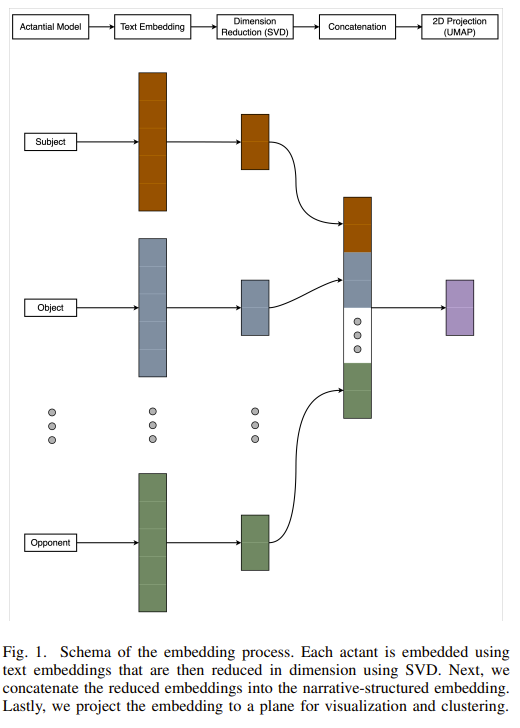
Let’s walk through the architecture.
1. Actantial model
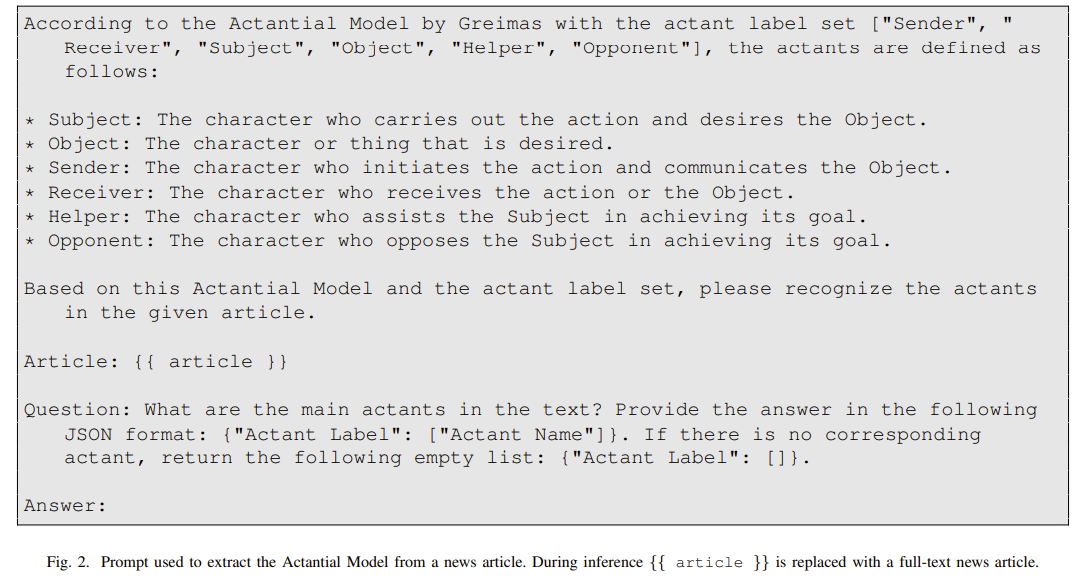
- Feed crawled articles into an LLM (Llama-3-8B-Instruct) and extract six actant roles.
The prompt is as follows.
Reproduction
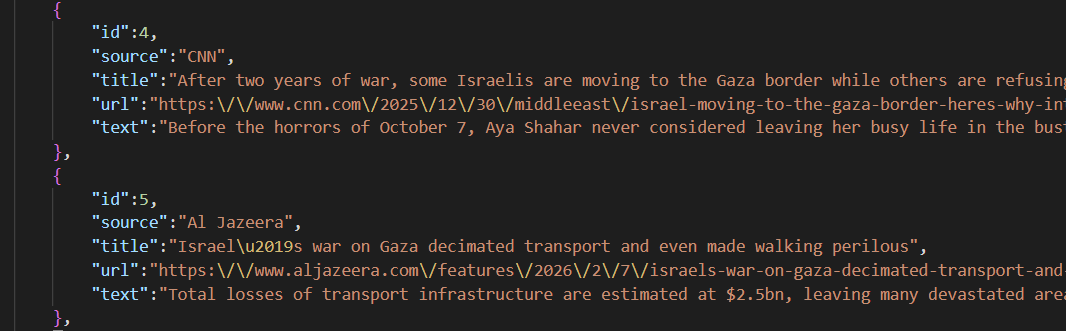
The output looks like this.
- Crawling The Washington Post kept getting blocked, so I used CNN instead.
- Due to broken links and crawling blocks, I manually collected five relevant articles each from CNN and Al Jazeera.
{
    "id": 0,
    "source": "CNN",
    "actants": {
        "Sender": [
            "Eyal Eshel",
            "Rafi Ben Shitrit"
        ],
        "Receiver": [
            "Prime Minister Benjamin Netanyahu",
            "The government",
            "The public"
        ],
        "Subject": [
            "Eyal Eshel",
            "Rafi Ben Shitrit",
            "The October Council"
        ],
        "Object": [
            "Truth",
            "Accountability",
            "Investigation"
        ],
        "Helper": [
            "The October Council",
            "Bereaved families",
            "Survivors"
        ],
        "Opponent": [
            "Prime Minister Benjamin Netanyahu",
            "The government"
        ]
    }
}
This is one example JSON output, where a single article is split into six actant roles.
2. Embedding
- Embed the extracted actants into 1024-dimensional vectors.
- I use e5-large, a BERT-family model. GPT-style models are strong at generation, but BERT-style models are typically more cost-effective for embeddings.
3. SVD
- Apply SVD separately for each of the six roles, preserving order and role identity.
- SVD (Singular Value Decomposition) compresses the 1024-d space to its most informative core signal.
4. Concatenation
- After dimensionality reduction, concatenate the six role vectors into one long vector.
- I avoid mean pooling because summation destroys order information. (“Israel (Subject) attacks Gaza (Object)” vs. “Gaza (Subject) attacks Israel (Object)” become identical if you simply add vectors.)
5. 2D projection (UMAP)
- Final vector size = reduced SVD dimension (34 in the paper) × 6
- That is, 204 dimensions per article
- UMAP is a non-linear projection that flexibly preserves distances.
- SVD is a linear projection that captures directions explaining the largest variance.
- Since UMAP can become unreliable in very high dimensions, SVD is applied first as an intermediate step.
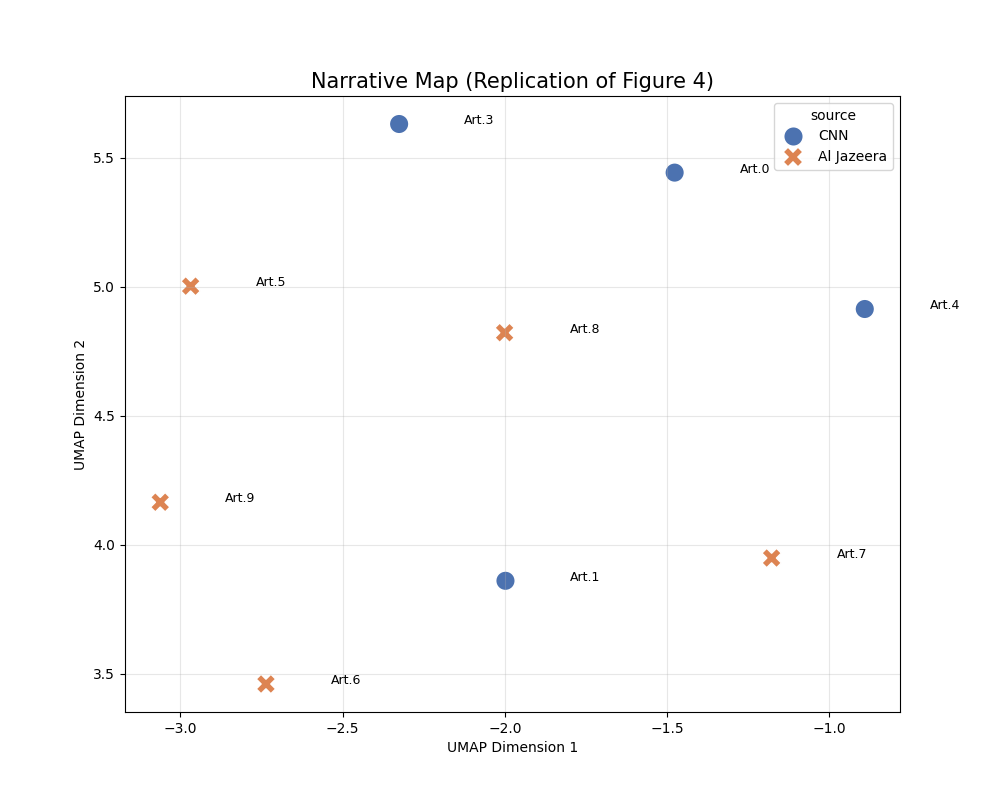
I only used 10 articles, so the plot is much smaller than the paper’s figure, but the clustering still works reasonably well.
Experiments & Results
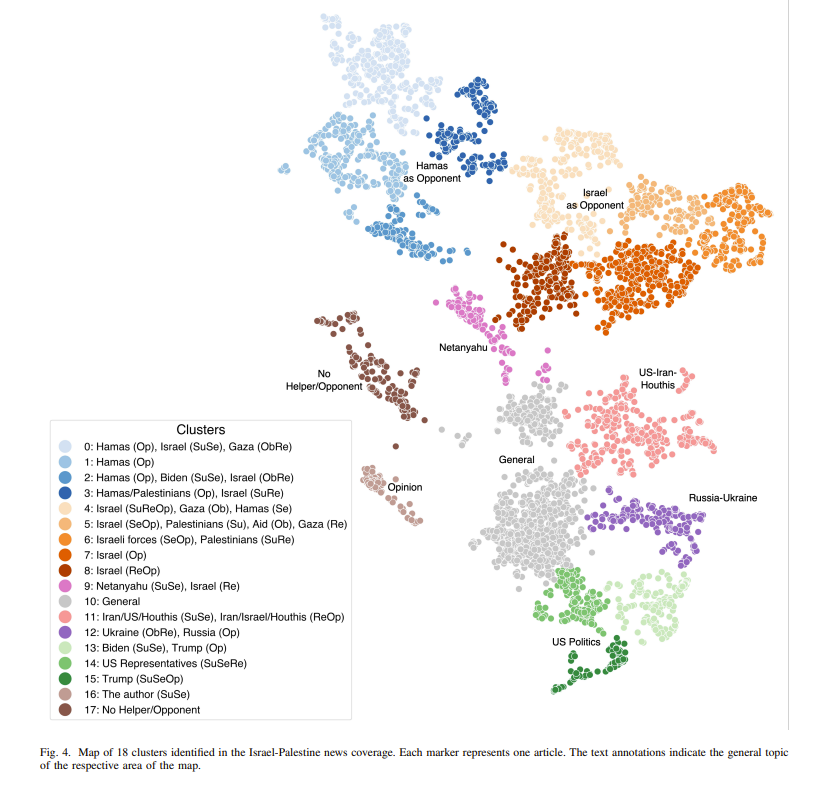
The paper collected 5,342 news articles and split them into 18 classes.
5342 news articles on the Israel-Palestine conflict, sourced from Al Jazeera and The Washington Post
As the figure shows, semantic distances separate cleanly with minimal overlap.
Additional study
To gain insight for my own research, I ran additional experiments.
Motivation
To use the paper’s idea as a justification and baseline for my research, I designed an additional experiment:
I applied the method to long-context novels. The key question was:
- Can the approach still compare narratives effectively for long text, not just short news articles?
To test generalization, I ran experiments on three popular English novels:
- Harry Potter 1
- LOTR 1
- DUNE 1
For narrative labels, I used three coarse themes—Battle, Daily, and Travel—and included the definitions in the prompt.
prompt_template = """
    Classify the following novel excerpt into one of these categories:
    1. "Battle": Fighting, danger, war, tension, sandworm attack.
    2. "Daily": Dialogue, politics, philosophy, rest.
    3. "Travel": Moving, desert crossing, ornithopter flight.

    Excerpt: "{text}"

    Question: Is this 'Battle', 'Daily', or 'Travel'? Answer with one word.
    Answer:"""
- Chunk length = 1,500 characters (~200–300 words)
- A typical novel page is about 1,500 characters
- e5-large has an input token limit (roughly 350–450)
- I used a 200-character overlap to reduce context loss
- e.g., 0–1500, then 1300–2800, etc.
- Chunks shorter than 1,500 characters were discarded
All other experiment settings (architecture, reduced dimension size, etc.) matched the paper.
The results are below.
-
Results
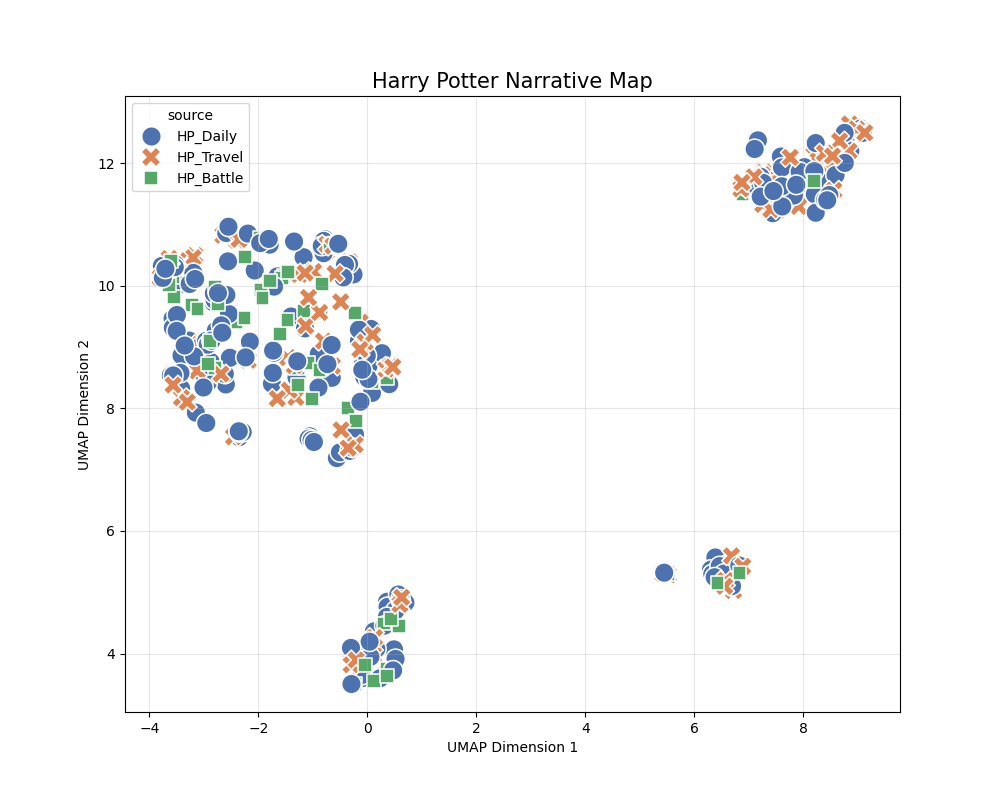
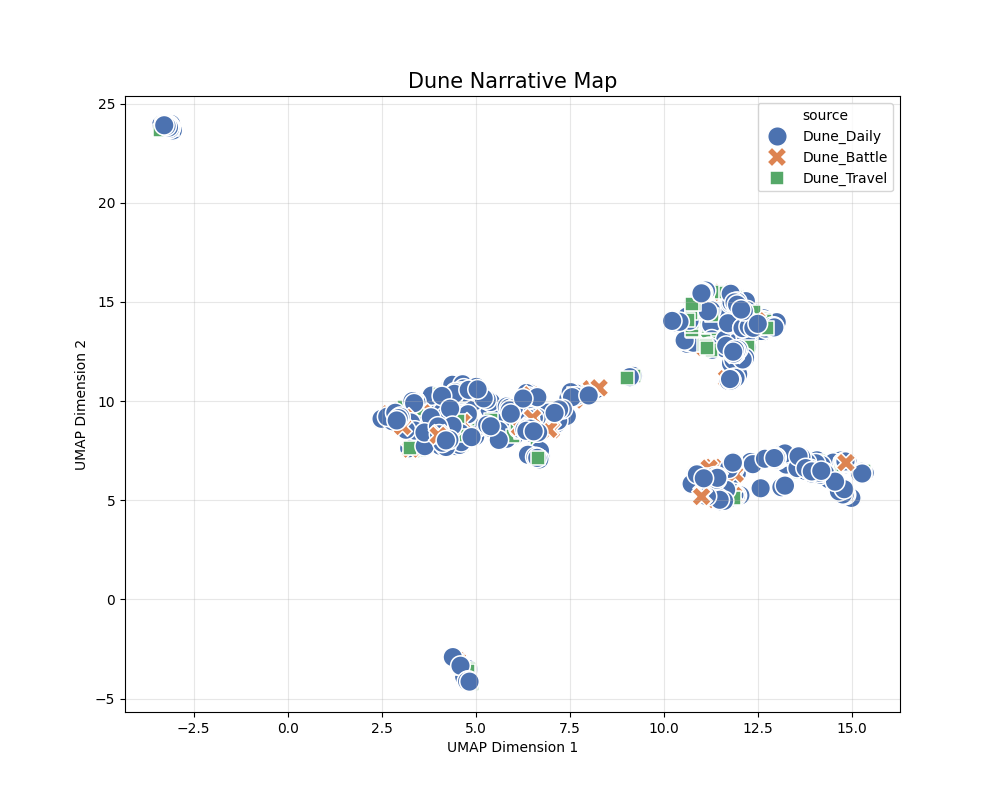
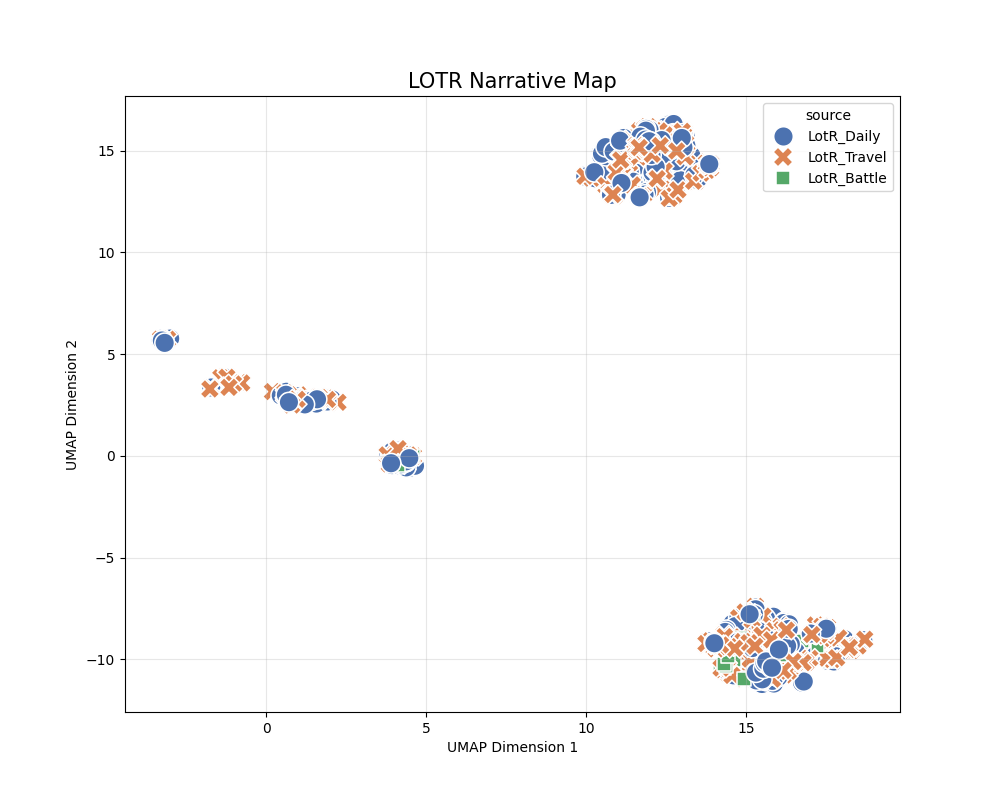
As shown, the clusters do not split cleanly into three groups as intended.
Possible causes include the following.
- Sparse vectors
- In the novel experiments, it was rare for all six actant roles to be filled for each of the three clusters.
- Examples:
- Travel:
Subjectexists, butOpponentorReceiverare often empty. - Daily:
SubjectandReceiverexist, butObjectorOpponentare often empty.
- Travel:
- This creates many near-empty null actants, which add noise during embedding.
- Limitations of embeddings themselves
- Ideal case: (Harry vs. Malfoy) and (Harry vs. Voldemort) should both map to Battle because they share the same action structure.
- In practice, the embeddings for “Malfoy” and “Voldemort” are far apart, so the scenes appear distant despite being the same narrative type.
To analyze this further (using Harry Potter as the reference), I ran two focused checks:
- Class A: Why are some samples close despite being in the same cluster?
- Class B: Why are some samples far despite being in the same cluster?
I computed similarity in the concatenated vector space before UMAP. Compressing to 2D can destroy information, so it is not a reliable similarity measure.
- 34 dimensions (SVD) × 6 roles = 204-dimensional similarity check
- Euclidean distance (L2)
- Only the Battle cluster
- Selected 2 samples from Class A and 2 from Class B, then prompted Meta-Llama-3.1-8B-Instruct.
-
Full prompt
  prompt_content = f"""
      Analyze why these two '{TARGET_CATEGORY}' scenes are {label.upper()} in vector space.

      [Scene A] (ID: {id1})
      - Actants: {json.dumps(act1, indent=2)}
      - Text: "{art1['text'][:300]}..."

      [Scene B] (ID: {id2})
      - Actants: {json.dumps(act2, indent=2)}
      - Text: "{art2['text'][:300]}..."

      [Task]
      Explain the distance ({dist:.2f}) based on:
      1. Entity Overlap (Do they share same character names?)
      2. Structural Patterns (Are the same roles filled/empty?)

      Answer:
      """
-
Result analysis
- Class A: Why are some samples close?
- DISTANCE: 0.0000
- One scene is essentially a paraphrase of another, producing near-identical actants (distance ≈ 0).
- DISTANCE: 0.4148
-
Scene A Actants: {“Subject”: [“Harry”, “Hagrid”], “Object”: [“the truth about Harry’s parents”, “Uncle Vernon”], “Sender”: [“Hagrid”], “Receiver”: [“Harry”, “Uncle Vernon”], “Helper”: [“Hagrid”], “Opponent”: [“Uncle Vernon”]}
- Scene B Actants: {“Subject”: [“Hagrid”, “Harry”], “Object”: [“Uncle Vernon”, “You-Know-Who”, “Harry”], “Sender”: [“Hagrid”], “Receiver”: [“Uncle Vernon”, “Harry”], “Helper”: [“Hagrid”], “Opponent”: [“Uncle Vernon”, “You-Know-Who”]}
- High actant overlap:
- Sender: ‘Hagrid’ in both scenes.
- Receiver: ‘Harry’ and ‘Uncle Vernon’ in both scenes.
- Helper: ‘Hagrid’ in both scenes.
-
- DISTANCE: 0.0000
- Class B: Why are some samples far?
-
Scene A Actants: {“Subject”: [“Hermione”], “Object”: [“the door”], “Sender”: [“Hermione”], “Receiver”: [“the door”], “Helper”: [“Harry”], “Opponent”: [“Filch”, “Peeves”]}
-
Scene B Actants: {“Subject”: [“Harry”], “Object”: [], “Sender”: [], “Receiver”: [], “Helper”: [], “Opponent”: []}
- Diverse character involvement: Scene A involves multiple characters (Hermione, Harry, Filch, Peeves), while Scene B focuses mostly on Harry.
- Different structural roles: Scene A has a richer actant structure; Scene B has many missing roles.
- Lack of shared context: The scenes come from different chapters with distinct settings and plot developments (e.g., Chapter 9 vs. Chapter 12).
-
In short, the key requirement is that all six actants align. Because many novel chunks lack full actant sets (especially Opponent in Daily/Travel), clean 3-way clustering is hard.
Therefore, a new approach is likely needed for long-context narratives such as novels.
댓글남기기